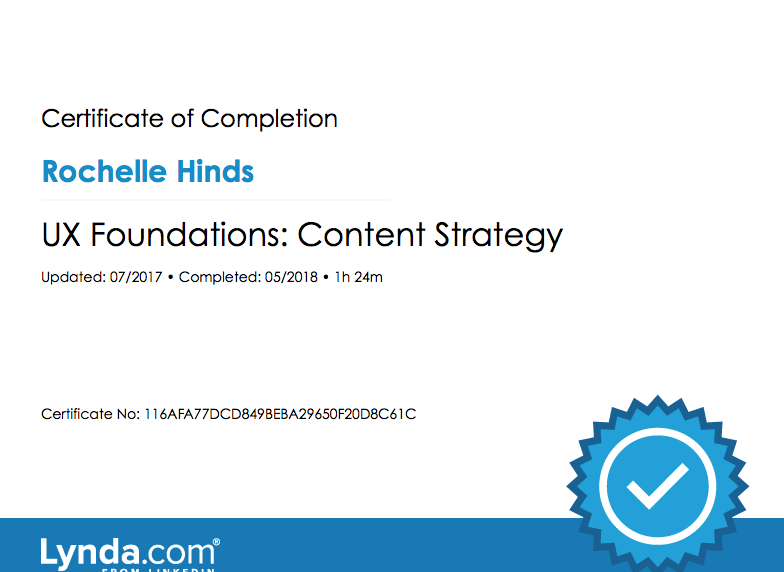
I am continuing on my learning path, this month focusing on writing and creating content for the web. As part of my research I recently completed the UX Foundations: Content Strategy course on Lynda.com.
If you’ve never taken a Lynda course, I highly suggest that you do.
This content strategy course was extremely educational for me. While it reaffirmed much of the knowledge and practices I put in place on a day-to-day basis for my clients, it did introduce me to some new ways of thinking regarding style guides, workflows, and content modeling.
For nearly half of my professional life I have worked in graphic and web design, so style guides for me have always been graphical design focus. Whether I was creating them or inheriting them, they were always focused on type, color, logo treatment, and all the visual things to ensure consistency of the brand across communication channels. This Lynda course introduced me to the idea that style guides can – and for many large companies – have evolved to include all types of content, not just the visual elements. Copy examples demonstrating voice and tone should be part of a brands style guide to ensure that from department to department – or working with 3rd parties – content creation is consistent and efficiently created.
Whether working alone or within a team, efficient workflows are crucial for executional success. Bottlenecks and loops of revision edits are not productive nor do they instill confidence, so creating a clear process for creation, revision, and publication can make or break an individual or team. Instinctively, I’ve always based my approach to projects by wire framing out a crude workflow for myself and others, but this course pointed out the necessity and value thoroughly created workflows can have for an individual or team. By clearly communicating ownership, and the process through which all pieces of content are to be created no room is left for ambiguity or confusion.
Content modeling is a practice that I’ve only truly been executing for the last 5 years of my professional life. It’s a practice I’ve fought many of my clients on as many of them simply wanted to “get up and running” with their social media presence and could not understand the importance of taking the time to build a content strategy – especially putting emphasis and effort behind building and understanding a content modeling structure. But I believe that content modeling creates the roadmap for all company members to create effective communication that always aligns with the business goals. Modeling forces you to strip away the things you throw in “because they feel right” and instead focuses you on the core communication/education needs to deliver.
One thing I plan to research more is persona development in relation to voice and tone. My first step when working with any client is developing a brand voice doc, working with the client through interviews and questionnaires to help me develop what I believe is the proper voice, tone, and even audience demographic they want to reach so I can create an effective social strategy plan and social content. My voice doc is very basic at this point, and this course introduced me to some deeper level questions and thinking that I like to learn more about and incorporate into my own exercises to improve and elevate them.
This course has motivated me to re-evalute the style guides of my current clients, and based on this learning I will elevate them all to include voice, tone, templates, examples and goals for content creation.